Bullet Journaling for Mental Health: A Guide
Learn how bullet journaling can support reflection through mood and habit tracking, plus a research-informed routine you can keep simple in daily life.
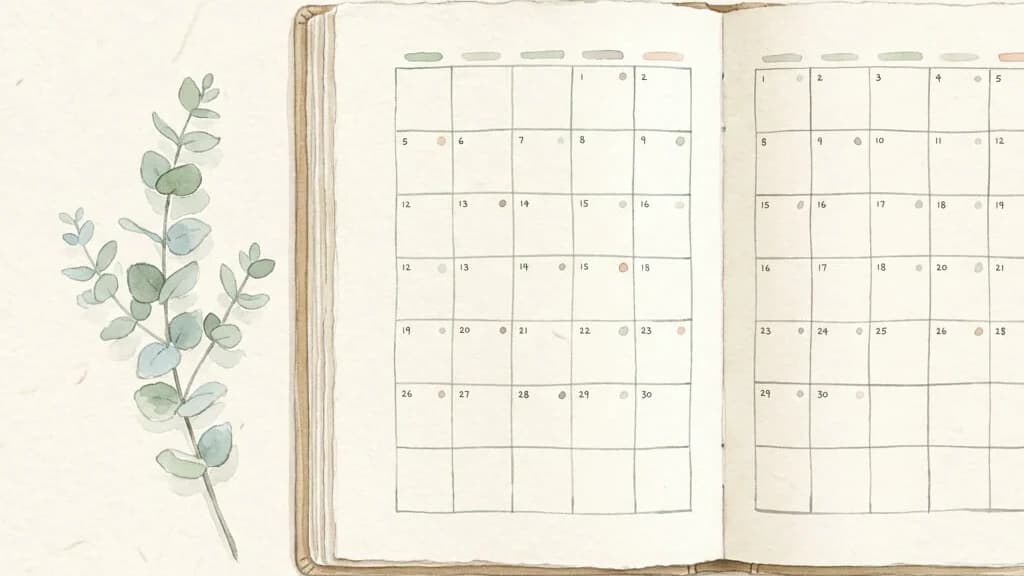
You've seen the photos: perfect spreads, hand-lettered headers, colour-coded habit trackers that look like they belong in a gallery. And somewhere between the admiration and the intimidation, you've probably wondered: does any of this actually help?
Several practices a bullet journal can contain — writing down future tasks, labelling emotions, and monitoring progress — have been studied. That does not make every spread a mental-health intervention, but it does suggest that the useful part has very little to do with how the journal looks.
What Is Bullet Journaling, Really?
The bullet journal method, often called BuJo, was created by Ryder Carroll, who developed it through years of experimentation while managing ADHD. The core system is deliberately simple: a notebook, a pen, and a shorthand notation system for tasks, events, and notes.
What distinguishes the bullet journal from a regular planner is rapid logging: the method's compact language for recording and revisiting what matters. It can hold a to-do list, diary notes, a mood tracker, and a calendar, but only as much as you need it to.
The aesthetic community that grew around it on Pinterest and Instagram is real, but it is not the method. The method is far quieter, and far more useful.
A Simple Spread You Can Use Today
Start with a date and three short lines. This fictional paper example uses a task, an event, and a note:
- Task: book the bike repair.
- Event: lunch with Noor.
- Note: felt scattered after a busy morning; lunch was a welcome pause.
At the end of the day, mark the task complete if you did it. Otherwise, decide whether it still matters and move it to a later date if needed. That decision is the useful output: a shorter, deliberate list for tomorrow.
An optional margin entry might read “Mood: 3/5.” Keep the same scale across the month. You can draw a grid or use the free Month in Pixels printable; blank days mean unrecorded, not a low mood score.
At review time, “I mentioned rushed mornings twice” is an observation. “Mornings cause my anxiety” goes beyond those notes. Our monthly-review example and checklist show how to keep that distinction clear.
This is a starter exercise inspired by rapid logging, not the complete Bullet Journal method. Its official guide explains bullets, collections, and migration.
The Science Behind Parts of the Practice
Three studied mechanisms help explain why parts of a journaling practice can be useful:
1. Cognitive Offloading
Writing tasks down is one form of cognitive offloading: using an external aid to reduce what a task asks you to hold and process internally.
In one small sleep-lab study, healthy young adults who spent five minutes writing a specific to-do list fell asleep faster than those who wrote about completed tasks. It was a one-night study, not evidence that list-making improves sleep for everyone, but it is a useful example of moving future tasks onto the page.
2. Affect Labelling
Putting an emotion into words can change how it is processed. In a well-known 2007 fMRI study, affect labelling reduced amygdala response to negative images relative to other encoding tasks and increased activity in a region involved in regulation.
A minimal mood label — a colour, a number, or a word beside the date — may use a related process. The study did not test daily mood tracking, so a label should be treated as a way to notice an emotion, not a guarantee that its intensity will fall.
3. Pattern Recognition Over Time
A single data point tells you how you felt on one day. Thirty data points give you a wider view. The monthly log in a bullet journal is, at its core, a visual pattern-recognition tool. Across randomized studies, interventions that increased monitoring of progress toward a goal produced a modest average improvement in goal attainment.
Mood is not a simple goal variable, and a pattern in a personal chart does not prove cause. But seeing that your energy often dips on Tuesdays, or that lower mood and less movement appear in the same weeks, gives you a concrete question to reflect on.
The Problem with Making It Pretty
Here is where bullet journaling culture can quietly work against you.
The pressure to create a beautiful spread, with hand-lettered titles, intricate habit grids, and washi tape, introduces friction that can defeat the purpose. Habit research supports keeping a repeated action simple and tied to a recognisable context; it does not establish an ideal-looking entry. A two-minute check-in that looks like a mess may be easier to repeat than a perfect layout that feels heavy to start.
Carroll's own guidance is to start simply: embellishment is useful if it motivates you, but it is not the core method.
Keep only the parts that help you decide, remember, or reflect. Decoration is optional, and a missed day does not require a replacement spread.
What to Actually Track for Mental Health
If you want a wellbeing spread, these are possible categories. The studies below concern different practices and populations; they do not rank the best things for you to track:
- Mood: a simple 1–5 scale or a colour is enough for a low-friction check-in. The goal is not precision; it is noticing.
- Sleep: duration and a rough quality rating. Sleep and mood influence one another from day to day, so sleep can be useful context alongside mood.
- Energy levels: distinct from mood. You can feel calm and depleted, or energised and anxious. Tracking both gives a fuller picture.
- Gratitude or highlights: one concrete positive observation per day. Gratitude exercises have produced small average improvements in depression and anxiety symptoms, with smaller effects against active comparison exercises. They are an optional prompt, not a substitute for care.
- Physical activity: not because you need to exercise more, but because activity is consistently associated with mental health. Recording it may add useful context to a mood log.
You don't need all five. Starting with one, done consistently, is the entire practice.
The Honest Case for Digital Tracking
Bullet journaling's analog nature is often cited as one of its strengths, but research does not justify a blanket claim that handwriting is always cognitively better than typing. Paper and digital writing create different experiences, and the useful format is the one that fits the task and is realistic to keep using.
For some people, a physical notebook is the ritual that makes the practice stick. For others, a phone they always have with them is the only format that realistically fits into their life. The best tracker is the one you actually use.
A digital tracker can make dated entries easier to revisit when your phone is nearby. That convenience does not establish the psychological benefits of the tool. A notebook gives you flexible layouts and task migration; Oubaitori supplies structured tracker entries and monthly views, and is not a full implementation of the Bullet Journal method.
If you are deciding between digital formats, our 2026 mood tracker app comparison separates quick logging, visual journaling, health detail, guided reflection, and modular tracking with monthly analytics by use case.
How Oubaitori Approaches This
Oubaitori was built around this philosophy. It brings the core of bullet journaling, the private, intentional check-in with yourself, into a calm, distraction-free digital space.
- Mood, health, gratitude, highlights, and more: each as a separate tracker you can add or remove as your season of life changes. No need to track everything at once.
- Tracker-specific monthly reflection: mixes, timelines, recurring themes, summaries, and prompts make different kinds of entries useful later.
- Choose your rhythm: set each enabled tracker to daily or occasional, depending on how it fits your life.
- Account-private entries: your journal has no public profile or social feed. Our privacy policy explains data handling and service providers.
For a concrete digital version, save a 3/5 rating in Mood, “Lunch with Noor” in Highlight, and Walking in the Activity Tracker. These are separate entries. Mood has no note field, and Activity uses preset choices rather than free text. Sleep records sleep and wake times; there is no separate energy or sleep-quality rating field.
Choose at least three trackers at setup and give each a daily or occasional rhythm; you can use just one on a particular day. My Days lets you revisit entries together by date. It does not infer causes or calculate cross-tracker correlations. Private entries require an internet connection, and account privacy is not end-to-end encryption.
Journaling and Oubaitori are not mental-health treatment. If tracking makes you feel worse, pause or simplify it; persistent distress is a reason to seek support from a qualified professional.
Starting Today: The Minimum Viable Practice
Whether you choose paper or digital, this evidence-informed starting point keeps the practice small:
- Pick one thing to track. Start with the signal you would still care about seeing at the end of the month.
- Give it a recognisable cue. Link the check-in to an existing event, like the end of your workday, brushing your teeth, or plugging in your phone. Stable contexts and repetition can support automaticity, although the evidence is not specific to journaling.
- Make it take less than two minutes. Complexity is the enemy of consistency. A number and a word is enough.
- Look back once a week. Even a short glance can reveal patterns worth asking about, without turning them into proof of cause.
That's it. The elaborate systems come later, if you want them. Most people find they don't need them.
Oubaitori is a private self-tracking app built for people who want to understand their own patterns, without the noise. Mood, gratitude, health, and more, in a calm, minimal space.
Create your account for a first Mood or Highlight entry →
Sources
The paper spread and digital entries are fictional examples. Product instructions were checked against the product guide on October 3, 2026. These sources distinguish the official method from research on individual practices.
- Bullet Journal. What Is the Bullet Journal Method?
- Risko, E. F., & Gilbert, S. J. (2016). Cognitive Offloading.
- Scullin, M. K., et al. (2018). The Effects of Bedtime Writing on Difficulty Falling Asleep.
- Lieberman, M. D., et al. (2007). Putting Feelings Into Words.
- Harkin, B., et al. (2016). Does Monitoring Goal Progress Promote Goal Attainment?.
- Cregg, D. R., & Cheavens, J. S. (2021). Gratitude Interventions: Effective Self-help?.
- Lally, P., et al. (2010). How Are Habits Formed?.