Oubaitori: A Japanese Metaphor for Growth
Discover Oubaitori, a Japanese expression and Buddhist teaching about distinct growth, with practical ways to loosen comparison in everyday life and reflection.
You open your phone and see a former classmate's promotion announcement. A friend posts a sunrise photo from their morning run. Someone else's perfectly organized home fills your feed. Within thirty seconds, a quiet voice in your head whispers: I'm behind.
That small ache of comparison can make an ordinary day feel inadequate. But a Japanese expression called Oubaitori (桜梅桃李) offers a gentler way to think about it.
What Does Oubaitori Mean?
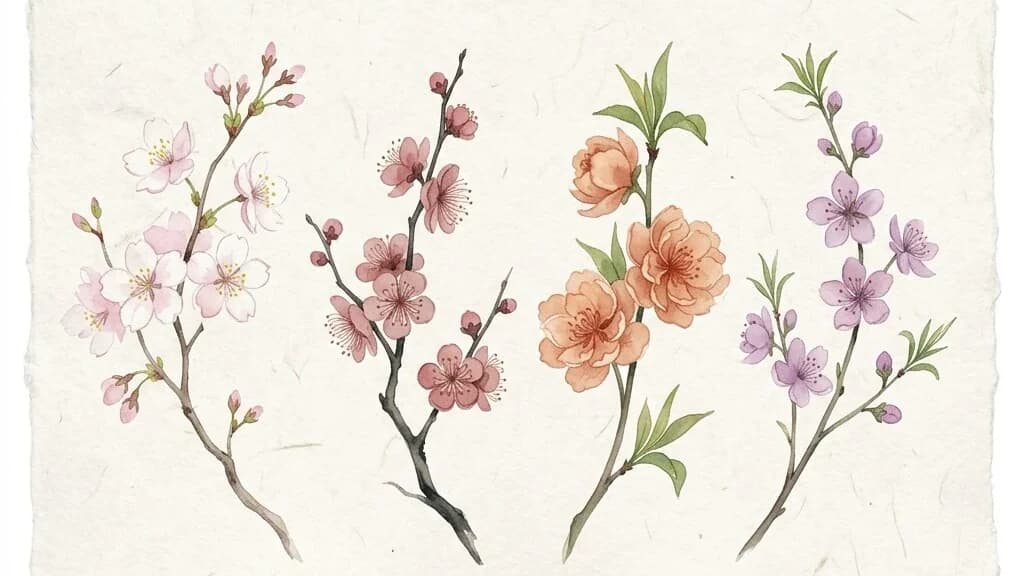
Oubaitori is a Japanese four-character expression composed of kanji for four flowering trees:
- Ou (桜) — cherry (sakura)
- Bai (梅) — ume, often rendered as plum
- To (桃) — peach (momo)
- Ri (李) — sumomo, often rendered as damson in English Buddhist sources
The four flowers appear together in older Japanese writing. Their flowering seasons can overlap, but the trees still flower in their own forms and rhythms — and that difference is part of what makes the season beautiful.
In a Nichiren Buddhist teaching, the four flowers become a metaphor for manifesting one's own nature rather than trying to become something else. Bloom in your own time is a modern, accessible way to apply that teaching, not a literal dictionary translation.
Why We Can't Stop Comparing Ourselves
Understanding why comparison feels so natural is a useful first step toward loosening its grip.
Social comparison theory, introduced by psychologist Leon Festinger in 1954, describes how people evaluate themselves partly through comparison with others, especially when objective standards are unclear.
Social media gives that tendency unusually frequent material: curated achievements, bodies, homes, and milestones from far beyond our immediate circles. Across experiments, exposure to upward comparison targets on social media produced small average declines in emotion and self-evaluation, including self-esteem and subjective well-being.
Those effects varied across people and outcomes; upward comparison can sometimes motivate as well as discourage. The evidence supports a risk pattern, not a universal spiral.
Oubaitori is not naive about this. It does not simply tell you to "stop scrolling." It offers a more useful reframe of what growth actually means.
Bloom in Your Own Time: Applying Oubaitori to Self-Growth
Here are three ways to apply the metaphor to everyday reflection. They are our practical interpretation, not a clinical framework:
1. Your Growth Has Its Own Season
Just as the plum blooms in late winter while the cherry waits for warmer days, your growth in any area of life — career, relationships, health, creativity — has its own timing. Forcing yourself to grow at someone else's pace is like trying to make a plum tree flower in December.
This doesn't mean passivity. It means aligning your effort with where you genuinely are, not where you imagine you should be based on others' visible progress.
2. Different Flowers Cannot Meaningfully Compete
A plum blossom cannot "win" against a cherry blossom — they are fundamentally different expressions of spring. When you compare your chapter 3 to someone else's chapter 27, or your private struggle to their public highlight, you are comparing things that do not have much in common.
Your life circumstances, temperament, history, and values make your path uniquely your own. Oubaitori teaches us to take this seriously — not as consolation, but as fact.
3. Tending Your Garden is Enough
The most useful response to the comparison impulse is not to look away from others, but to turn toward yourself. Ask: what does growth look like for me, in this season of my life? What small, honest step can I take today?
This practice — noticing your own patterns, tracking your own rhythms, reflecting on your own progress — is the practical heart of living oubaitori.
A Reflection You Can Actually Write
Fictional example, not a testimonial. After seeing a friend announce a promotion, Alex writes in a notebook:
- Comparison: “Everyone is moving forward except me.”
- Context: “I changed roles this month and am learning a new routine.”
- One thing I want to remember: “I asked a colleague for help instead of staying stuck.”
- A next step that fits: “Make space for one question in tomorrow’s check-in.”
The output is one action Alex can choose, rather than a verdict on whose career is ahead. The exercise does not require turning a hard day into a positive one.
In Oubaitori, the memorable sentence could become a Highlight entry, or the comparison could be journaled in Friction. A separate Mood rating records how the day felt; it has no text field. These examples use existing trackers, not a dedicated comparison exercise in the app.
At the end of the month, Alex can reread the entries in My Days and ask, “What mattered in the circumstances I actually had?” The monthly-review guide shows how to do that with incomplete entries and room for uncertainty.
Research Near the Practice
Research has not tested oubaitori as a psychological intervention, and private tracking is not automatically treatment. A few adjacent findings can still help us describe what reflective practices may do.
In a small 2018 randomized trial, medical patients with elevated anxiety used a structured positive-affect journaling program for 12 weeks. The group reported some improvements relative to usual care. This supports one specific writing exercise; it does not show that every kind of journaling, or any daily tracker, produces the same effects.
Research on affect labelling offers another nearby mechanism. In a 2007 fMRI study, putting words to emotions shown in negative images changed activity in regions involved in emotional processing. A mood grade may involve a similar act of labelling, but it is not guaranteed to reduce emotional intensity or improve mental health.
The modest case is enough: private tracking can redirect attention from someone else's visible timeline toward your own experience, giving you something concrete to revisit.
How Oubaitori Shapes the App
The Oubaitori app was built around this philosophy. Every design decision comes back to one question: does this help someone tend their own garden, or does it tempt them to look at others'?
Here is what that means in practice:
- No social feeds, rankings, or leaderboards. Entries belong to your account and have no public profile. This is account privacy, not a promise of end-to-end encryption or that service providers never process data; see the privacy policy.
- Modular trackers that fit your season. Choose at least three during setup, then set a daily or occasional rhythm for each. You can save one entry today without completing every enabled tracker.
- Monthly reflection. Tracker summaries and My Days help you revisit what you recorded. They do not calculate correlations between trackers, identify causes, or diagnose conditions. You supply the context.
- A rhythm you choose. The product has no streaks. Optional daily reminders and saved-quote notifications are controlled in Settings. Loading and saving private entries requires an internet connection.
Embracing Your Season, Starting Today
Whether you are in a quiet winter of rest — gathering strength that no one else can see yet — or a visible spring of growth, your timeline is not wrong. It is yours.
The plum tree does not need to become the cherry. Each flowers in its own form and rhythm.
That is oubaitori. And it is available to you, exactly as you are.
Ready to tend your own garden? Oubaitori helps you track your mood, health, gratitude, and daily highlights — privately, simply, and on your own terms.
Create your account and journal one moment from today →
Oubaitori is free during early access. The metaphor and this exercise are invitations to reflect, not evidence that the app treats anxiety or other mental-health conditions.
Sources
Alex’s entries are fictional, and the exercise is an editorial application of the metaphor. Product details were checked against the product guide on October 3, 2026. The historical and Buddhist sources establish context; they do not establish a mental-health effect.
- Soka Gakkai Japan. The Meaning and Origins of 桜梅桃李.
- Soka Gakkai International. Cherry, Plum, Peach, and Damson.
- Ministry of Agriculture, Forestry and Fisheries of Japan. The History and Flowering Seasons of Japan's Cherry, Ume, and Peach Trees.
- Festinger, L. (1954). A Theory of Social Comparison Processes.
- McComb, C. A., Vanman, E. J., & Tobin, S. J. (2023). A Meta-Analysis of Social Media Exposure to Upward Comparison Targets.
- Smyth, J. M., et al. (2018). Online Positive Affect Journaling in General Medical Patients With Elevated Anxiety Symptoms.
- Lieberman, M. D., et al. (2007). Putting Feelings Into Words.